
Faculty 04: Production Engineering - Mechanical Engineering and Process Engineering

The University of Bremen is entering the race for excellence with two cluster applications

The full proposal from Bremen is entitled "The Mars Perspective: Resource Scarcity as the Basis of a Paradigm of Sustainability". "With the Mars Perspective, we will rethink the production of materials under the premise of resource scarcity," said Marc Avila, spokesperson for the cluster initiative and head of the Center for Applied Space Technology and Microgravity at the University of Bremen.

Prof. Dr. Kurosch Rezwan

Transfer project

University of Bremen as a pioneer: 30 million euros for the first center for accelerated technology transfer.

Bringing research to market readiness more quickly - that is the goal of the first "innovate! Center" in Germany. Sustainable solutions for technological challenges will be developed in three pilot projects from 2025. The Joachim Herz Foundation is supporting the venture with up to 30 million euros.

Veranstaltungen

25.15. Mar Apr
Wanderausstellung: "Standing for freedom"
Neue Kassenhalle (Jakobistrasse 1, Rückseite des alten Sparkassengebäudes, 28195 Bremen)
18:00 17:00
More
07. Apr
Arzt. Astronom. Bremer. Wilhelm Olbers (1758 – 1840) und sein Nachlass in der SuUB Bremen.
Staats- und Universitätsbibliothek Bremen
16:30 Open End
More
08. Apr
Aus den Akten auf die Bühne - Karrieren in Bremen nach 1945 - Kurt A. Becher – Käthe Popall – Alfred Ries
Theater am Leibnizplatz
19:00 21:30
More
09. Apr
Prof. Dr. Matthias Bartelmann (Universität Heidelberg): On the similarity of cosmic structures
Hörsaal H3, Geb. NW1, Otto-Hahn-Allee 1, 28359 Bremen
16:00 17:00
More
14. Apr
Info-Veranstaltung: Master Public Health – Gesundheitsförderung und Prävention
Zoom
18:00 19:00
More
14. Apr
„Versäumte Bilder“ – Ausstellung und Public Lecture im Forum am Domshof
Forum am Domshof
18:00 19:30
More
15. Apr
Linux-Install-Party in der SuUB
Staats- und Universitätsbibliothek Bremen
15:00 18:00
More
15. Apr
Tag der Forschungsdaten - Triff den Datenraum Nordwest
Forum am Domshof, Kassenhalle
16:30 21:00
More
15. Apr
Info-Veranstaltung: Master Public Health – Gesundheitsversorgung, -ökonomie und -management
Zoom
18:00 19:00
More
15. Apr
Nachhaltige kommunale Bewegungsförderung: ein Selbstläufer?
Haus der Wissenschaft
18:00 19:30
More
16. Apr
Johannes Quaas (Universität Leipzig): Solar radiation modification - scenarios, risks, challenges and prerequisites
Hörsaal H3, Geb. NW1, Otto-Hahn-Allee 1, 28359 Bremen
16:00 17:00
More
20. Apr
From Data to Discovery: Autonomous Discovery and In-Depth Characterization of Novel Functional Materials
NW1, W1180
16:00 17:30
More
20. Apr
Info-Veranstaltung: Master Community and Family Health Nursing: Versorgungsforschung und Versorgungsplanung
Zoom
18:00 19:00
More
21. Apr
Casey Walsh (UC Santa Barbara): "Visibility and Property in California's Sustainable Groundwater Management Act (SGMA)."
Universität Bremen, GW2 B1216
16:15 18:00
More
21. Apr
Info-Veranstaltung: Master Epidemiologie
Zoom
18:00 19:00
More
21. Apr
Von Zeugen und Helden. Juden in der Roten Armee
IW 0330
18:15 19:45
More
23. Apr
Prof. Dr. Rafaela Hillerbrand (Karlsruhe Institute of Technology): Dual Use, Risk, and Responsibility in Physical Research
Hörsaal H3, Geb. NW1, Otto-Hahn-Allee 1, 28359 Bremen
16:00 17:00
More
23. Apr
Arbeiten auf hoher See – Dynamiken und Herausforderungen der globalen Kreuzfahrtindustrie
Forum am Domshof, R: 500.01
16:00 18:00
More
27. Apr
Info-Veranstaltung: Lehramt studieren an der Uni Bremen
Zoom
15:30 17:00
More
27. Apr
“Über der Tatra blitzt es.” Die umkämpfte Demokratie in der Slowakei
Europapunkt Bremen
18:00 19:30
More
29. Apr
Aus den Akten auf die Bühne - Reichsführers gehorsamster Becher: Vom SS-Standartenführer zum Millionär
Theater am Leibnizplatz
19:00 21:30
More
06. May
Studienplatzbewerbung an der Uni Bremen
Zoom
15:30 17:00
More
07. May
Politikwissenschaftliche Masterprogramme stellen sich vor
Zoom
10:00 12:00
More
07. May
Prof. Dr. Björn Poppe (Carl von Ossietzky Universität Oldenburg): Von der Klinik ins All: Anwendungen der Medizinischen Strahlenphysik zwischen Klinik und Raumfahrt
Hörsaal H3, Geb. NW1, Otto-Hahn-Allee 1, 28359 Bremen
16:00 17:00
More
07. May
Rasender Stillstand. Belarus – eine Revolution und die Folge
Europapunkt Bremen
18:00 19:30
More
11. May
Cinemas in Soviet Russia during the 1920s: A New Culture of Leisure
IW3 0330
18:15 19:45
More
12. May
Aus den Akten auf die Bühne - Karrieren in Bremen nach 1945 - Kurt A. Becher – Käthe Popall – Alfred Ries
Theater am Leibnizplatz
19:00 21:30
More
13. May
Info-Veranstaltung Master Public History
Zoom
15:00 16:00
More
18. May
Kampf um die Freiheit. Georgien und der lange Arm des Kreml
Kassenhalle am Domshof
18:00 19:30
More
20. May
Hitzeschutz im Alter - Einfluss von Wohnbedingungen, ausreichender Flüssigkeitszufuhr und sozialen Faktoren
Haus der Wissenschaft
18:00 19:30
More
20. May
Aus den Akten auf die Bühne - Reichsführers gehorsamster Becher: Vom SS-Standartenführer zum Millionär
Theater am Leibnizplatz
19:00 21:30
More
21. May
Prof. Dr. Susanne Glaser (Uni Bonn): Geodäsie
Hörsaal H3, Geb. NW1, Otto-Hahn-Allee 1, 28359 Bremen
16:00 17:00
More
26. May
Info-Veranstaltung Master Public History
SFG, Raum 1010
16:00 17:00
More
28. May
Info-Veranstaltung: Studieren in Bremen und Bremerhaven
Zoom
16:00 18:00
More
01. Jun
Als wäre es vorbei. Texte aus dem Krieg
Haus der Wissenschaft
19:30 21:00
More
02. Jun
Felipe Fernandes (Universität Freiburg) “Water, Infrastructure and Urban Violence in the Port-City of Buenaventura, Colombia.”
Universität Bremen, GW2 B1216
16:15 18:00
More
02. Jun
Aus den Akten auf die Bühne - Reichsführers gehorsamster Becher: Vom SS-Standartenführer zum Millionär
Theater am Leibnizplatz
19:00 21:30
More
08. Jun
Ukrainische Sprachdebatten. Aushandlungen von Zugehörigkeit, Legitimität und Authentizität vor und nach 2022
IW3 0330
18:15 19:45
More
10.11. Jun
vocatium
Messe in Halle 6, Bremen
08:30 15:00
More
10. Jun
Klimaanpassung in der Bremer Innenstadt - ein Klima-Spaziergang
Haus der Wissenschaft
18:00 19:30
More
11. Jun
Dr. Odele Straub (Exzellenz-Cluster "Origins", München): Vom Urknall bis zur ersten Zelle
Hörsaal H3, Geb. NW1, Otto-Hahn-Allee 1, 28359 Bremen
16:00 17:00
More
13. Jun
OPEN CAMPUS
Campus der Universität Bremen
All day
More
13. Jun
Open Campus der Universität Bremen
All day
More
15. Jun
Am Rande des Abgrunds: Literarische Darstellungen des Holocaust in der Sowjetunion
IW3 0330
18:15 19:45
More
15. Jun
Gesellschaftliche Unterschiede: Warum wir uns voneinander untrscheiden und warum das (manchmal) wichtig ist
Hanse-Wissenschaftskolleg, Lehmkuhlenbusch 4, 27753 Delmenhorst
19:30 21:00
More
18. Jun
Prof. Dr. Tobias Voß (TU Braunschweig): Titel folgt
Hörsaal H3, Geb. NW1, Otto-Hahn-Allee 1, 28359 Bremen
16:00 17:00
More
19. Jun
Info-Veranstaltung Master Public History
Zoom
10:00 11:00
More
22. Jun
Info-Veranstaltung: Lehramt studieren an der Uni Bremen
Zoom
15:30 17:00
More
22. Jun
Queer-Fanfiction vs. politische Homophobie: Umstrittene Erinnerungen an den Zweiten Weltkrieg in Russland
IW3 0330
18:15 19:45
More
24. Jun
Info-Tag für Studieninteressierte 2026
Campus der Uni Bremen
08:30 16:00
More
25. Jun
Dr. Frank Steier (OHB Bremen): LISA
Hörsaal H3, Geb. NW1, Otto-Hahn-Allee 1, 28359 Bremen
16:00 17:00
More
29. Jun
Civil War Anxiety in Russian: Political Emotions from Perestroika to the “Wild Nineties”
IW 0330
18:15 19:45
More
30. Jun
Thiago Barbosa (Leipzig) "Lithium Extractivism and Indigenous (Un)futurism in Brazil."
Universität Bremen, GW2 B1216
16:15 18:00
More
06. Jul
Auf dem Weg zu einem „gemeinsamen europäischen Haus“? Der Boom der westdeutsch-sowjetischen Städtepartnerschaften in der Perestrojka
IW 0330
18:15 19:45
More
09. Jul
Dr. Giuseppe Romano (MIT-IBM Watson AI Laboratory): Titel folgt
Hörsaal H3, Geb. NW1, Otto-Hahn-Allee 1, 28359 Bremen
16:00 17:00
More
17. Aug
Bernsteine: Zeitkapseln der Evolution
Hanse-Wissenschaftskolleg, Lehmkuhlenbusch 4, 27753 Delmenhorst
19:30 21:00
More
03. Sep
Warum wir wählen, was wir wählen: Unser Wahlverhalten in unsicheren Zeiten
VHS Delmenhorst, Am Turbinenhaus11, 27749 Delmenhorst
19:30 21:00
More
08. Sep
20 Jahre Kriseninterventionsteam Stalking (Stalking-KIT) in Bremen
Forum am Domshof
10:00 17:00
More
05. Oct
Wahlmanipulation im digitalen Zeitalter: Wo liegen die Gefahren?
Hanse-Wissenschaftskolleg, Lehmkuhlenbusch 4, 27753 Delmenhorst
19:30 21:00
More
29. Oct
Prof. Dr. Michèle Heurs (Uni Hannover und DESY/DZA): Titel folgt
Hörsaal H3, Geb. NW1, Otto-Hahn-Allee 1, 28359 Bremen
16:00 17:00
More
02. Nov
Wölfe in Niedersachsen
Hanse-Wissenschaftskolleg, Lehmkuhlenbusch 4, 27753 Delmenhorst
19:30 21:00
More
12. Nov
Info-Veranstaltung: Studieren in Bremen und Bremerhaven
Zoom
16:00 18:00
More
All Events

Mission statement FB4

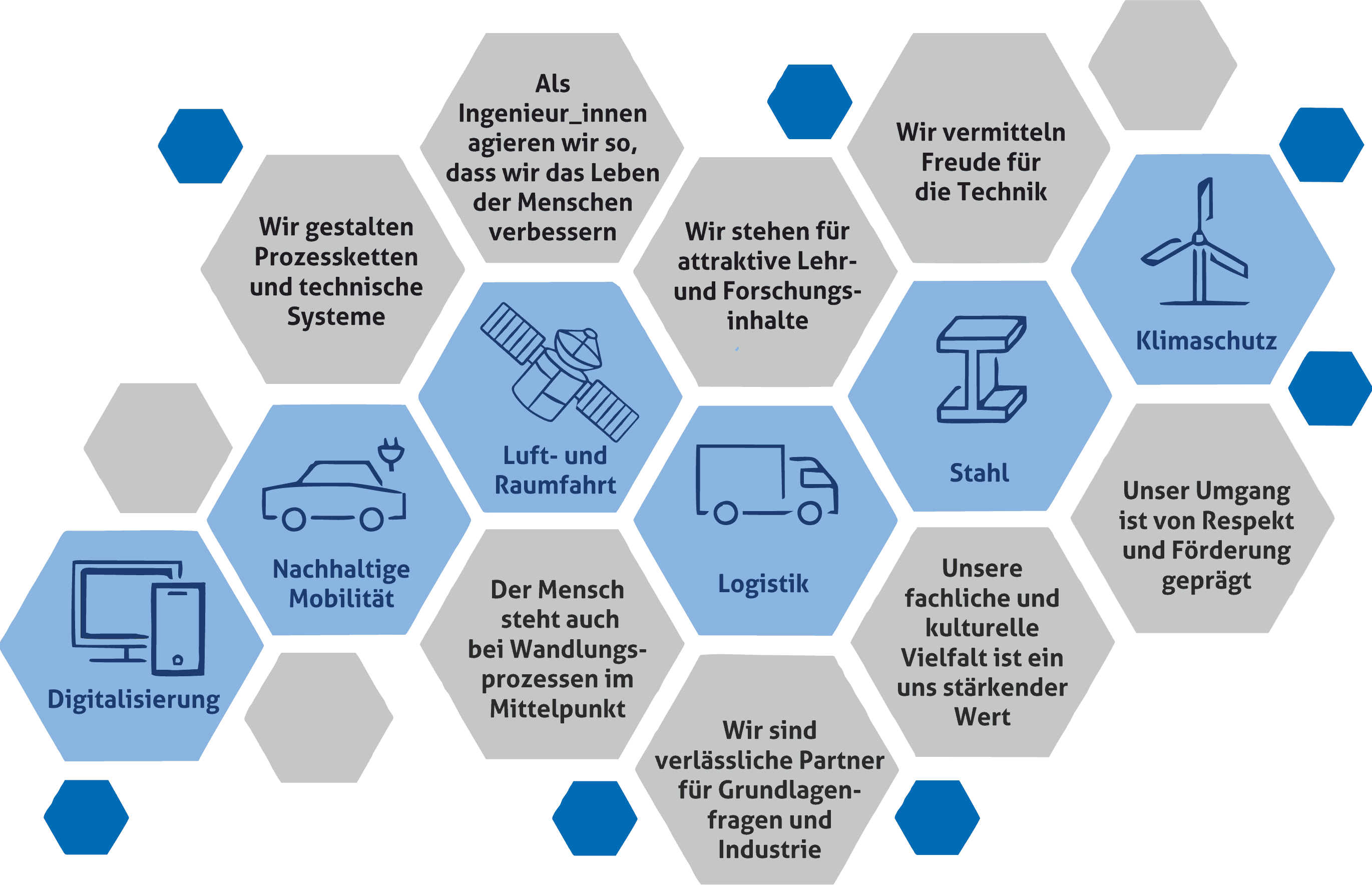
The guiding principles are listed below. Below are the statements that were developed in a departmental meeting.


We are internationally visible and attractive in research and teaching.

The FB4 is internationally perceived as a beacon in research and teaching.

The attractiveness is expressed, among other things, in the fact that both the research topics and approaches as well as the degree programs are internationally sought after.

Research and teaching continue to be characterized by the top performances of individuals. However, these achievements are not singularities, but rather building blocks of a homogeneous overall picture.

We recognize trends early on and integrate them into teaching and research.

We train people to solve social challenges with new technologies.

Through training at the FB4, people are prepared for numerous and diverse career paths. They learn the basics of engineering using specific technologies in manageable groups. In addition to the technical aspects, we promote the skills and competencies of the people in the FB4 and thus develop personalities for business and science. Ultimately, we are the springboard to the future.

We develop further in line with the changing requirements of the FB; this applies to both HL and the middle management.

We are achieving full teaching capacity.

We are increasing the proportion of external students to 30%. [External = high school diploma outside a 100 km radius].

Because of our attractiveness, we have more applicants than places

We have clearly identifiable priorities: the design of process chains and technical systems in which we contribute to solving social challenges.


We research technologies to improve people's lives. This is one way to put people at the center. To this end, we act as engineers who actively shape the future of our society through research and teaching. In doing so, we work coherently on sustainable, technical solutions.


We have a strategy and staff for external communication.

We communicate science to the outside world and internally using modern media in a target group-oriented manner.

We convey joy and arouse enthusiasm for technology.

We have a clear line that we stand by reliably, without losing our ability to change and adapt. People are always the focus here.

The teachers' individual enthusiasm for technical solutions that serve people is contagious and carries the learners along with them.

We actively support our students in their personal and professional development.

We allow for individuality and value it without losing sight of the bigger picture.

The diversity of the focus areas offers numerous interfaces where the subject boundaries can be left (transdisciplinarity) without giving up the identity of the individual groups.

The wide thematic breadth of the subject areas, combined with the close internal networking, allows for rapid exchange on a variety of topics and thus also close-meshed trend scouting.

Fields of action are derived from the focus areas of the department, which are regularly evaluated.

Based on strong basic research, we develop innovative technologies with industry.

The stakeholders see us as reliable partners and experts in solving social problems.

We look at every question from different perspectives (inter-/transdisciplinary).

All university lecturers are involved in undergraduate teaching.

We enable the development and implementation of new ideas and act as an incubator for spin-offs managed by employees.

Students feel that they are treated fairly and respectfully.

We live a common FB culture whose decisions are based on the principle of strong consensus. [Strong = 80% of people agree at least 80% of the time].

The FB and the non-university institutes managed by its members act in a unified manner in research and teaching.
Updated by: bolik